
Note: In the macro-background of the "China Outlook 2026", Chinese-funded enterprises' overseas expansion in Southeast Asia has already bid farewell to the early "horse racing" and entered the 2.0 era of "deep roots". Cost advantages and tax dividends are no longer the absolute winner in competition. As regulatory rules in Southeast Asian countries become increasingly strict and law enforcement continues to escalate, Chinese companies are facing the pain of transformation from "guerrilla" to "regular army." The standardization level of corporate governance and the resilience to resist compliance risks** have become the core key to determining whether they can gain a foothold in Southeast Asia.
In 2026, Chinese-funded enterprises will go to Singapore and Southeast Asia to carry out compliance governance. The core challenges are concentrated in three major dimensions. Each dimension is a threshold that enterprises must cross from "formal implementation" to "substantial rooting".
Some of the opinions in this article were previously published in reports related to the "OUTLOOK 2026" report released by Thomson Reuters Regulatory Intelligence & CUBE Global. We now conduct a systematic extended analysis based on the interview content.
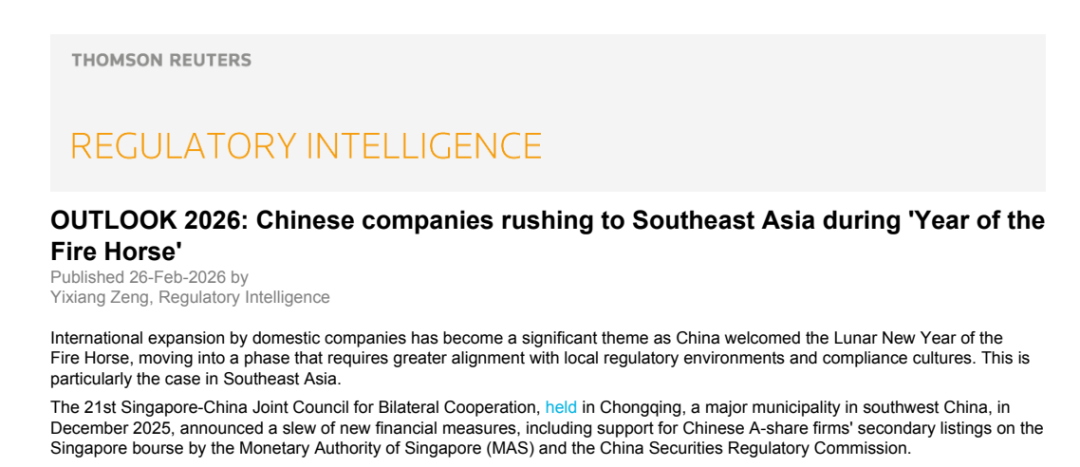
Picture: Excerpt from Thomson Reuters Regulatory Intelligence & CUBE Global's "OUTLOOK 2026" report
1. Singapore: From tax hub to substantive operational compliance highland
For a long time, Singapore has become an important hub for Chinese-funded enterprises to go overseas in Southeast Asia with its loose tax policy and perfect financial system. Now, this hub is tightening the "compliance gate" - the implementation model that used to focus on the advantages of tax structure is being reshaped by more stringent economic substance requirements.
From “looking at books” to “looking at reality”, the economic substance review has been comprehensively upgraded
Previously, if Chinese-funded enterprises established entities in Singapore and wanted to enjoy 13O/13U and other fund tax preferential plans, they only needed to meet the book asset standards to complete the registration. Some enterprises even only set up shell offices and had no actual business activities to achieve tax exemption.
However, starting from 2025, the Inland Revenue Authority of Singapore (IRAS) continues to strengthen the economic substance review under the tax preference framework, and two key changes have occurred in the core requirements:
- Asset measurement is no longer limited to net book value, and must strictly comply with the compliance scope of "Designated Investment (DI)" to eliminate false asset allocation;
- Local business expenditure (LBS) is directly linked to asset size. Enterprises must have real local employees, have substantive decision-making functions, and carry out Normalized business activities and empty shell operating space are being significantly compressed.
To put it simply, Singapore’s tax incentive system is further tilted towards companies with “substantial operations”.
The “carrot + stick” of the new tax regulations anchors high-quality and real investment
With the global minimum tax (BEPS2.0) rules fully implemented, the 15% bottom-line tax rate has become an unavoidable and mandatory requirement for group companies with annual revenue of no less than 750 million euros. This means that leading Chinese-funded companies have no room to operate if they want to rely on simple tax planning to reduce their tax burden.
At the same time, Singapore has also launched a "Refundable Investment Tax Credit (RIC)" policy to provide a "carrot" of tax incentives: if companies truly invest in research and development and establish physical operations in Singapore, part of the eligible tax burden can be alleviated through refundable investment tax credits.
With the stick and the dill, Singapore's policy direction has become increasingly clear: while maintaining tax competitiveness, it places greater emphasis on high-quality, sustainable substantive investment.
2. Southeast Asia: Hidden rules have withdrawn, and compliance has fallen into a “maze of fragmentation”
Outside of Singapore, the compliance challenges faced by Chinese-funded enterprises have become more complex - the regulatory rules in neighboring countries lack unified standards, forming a "fragmented maze" that is difficult to overcome. The unspoken rules of the industry have become ineffective one after another, and data compliance and equity structures have become two high-frequency risk points.
The judicial structure of agency holding has collapsed, and penetrating supervision has become the norm.
In the past, in order to circumvent foreign investment access restrictions in Thailand, Indonesia and other countries, Chinese-funded enterprises often used local entities to hold shares on behalf of their clients. This "hidden rule" has been widely used and has become a "shortcut" for enterprises to bypass supervision.
However, in recent years, the regulatory trend in Southeast Asian countries has turned to "penetrating supervision", and the legal risks of agency holding structures have exploded: Indonesian courts have recently appeared in relevant cases, directly ruling that such agency holding agreements are invalid due to violation of mandatory regulations on foreign investment access. The companies involved not only face legal disputes over equity ownership, but may also suffer serious consequences such as the revocation of operating licenses and suspension of business for rectification, and the initial investment is wasted.
Data sovereignty is tightened, operations are forced to be "fragmented", and compliance costs soar
In recent years, data protection supervision in Vietnam, Indonesia and other countries has continued to strengthen enforcement. Among them, the regulatory framework with Vietnam's Personal Data Protection Law (PDPL) and supporting regulations as the core has put forward strict requirements for the cross-border operations of Chinese-funded enterprises.
For cross-border data transfer in specific scenarios, companies not only need to complete data impact assessments, but also need to formally report to local regulatory agencies; at the same time, coupled with the data localization requirements under the "Cybersecurity Law", the "regional data center centralized operation" model previously established by Chinese companies in pursuit of cost optimization is completely unworkable.
In order to meet the compliance requirements of various countries, companies have to abandon centralized operations and deploy IT infrastructure and data processing systems in multiple countries. This not only significantly increases technology investment and labor costs, but also greatly reduces the synergy of regional operations and significantly increases compliance costs.
3. Dispute Resolution: Say goodbye to away games, prioritize building a secure line of defense
As Chinese-funded enterprises gradually enter the "deep-water zone" fields such as manufacturing and energy in Southeast Asia, the investment scale is larger and the cooperation entities are more complex. The probability of commercial disputes has also increased significantly**. However, the local judicial protectionism that exists in some countries makes it easy for Chinese companies to fall into the passive situation of "fighting away from home" in dispute resolution. How to avoid the uncertainty of refereeing has become an important part of compliance governance.
Anchoring Singapore to build a core hub for dispute resolution in Southeast Asia
Faced with the potential risk of judicial protectionism, more and more Chinese-funded enterprises have begun to change their thinking and regard Singapore as the core hub of regional governance and dispute resolution in Southeast Asia. They have built a solid legal "safety cushion" through advance contract structure design. The core operation method is very clear: in the commercial contract, it is directly agreed that the Singapore International Arbitration Center (SIAC) will serve as the dispute resolution institution. Compared with judicial procedures in some Southeast Asian countries, SIAC arbitration has two core advantages:
- Strong independence, which can effectively avoid the interference of local judicial protectionism, and the ruling results are more fair;
- The procedure is efficient, ordinary cases can usually be concluded within 12-18 months, and simplified procedures can be as low as 6 Within months, disputes can be resolved quickly and the company’s operating losses can be minimized.
This “structure first” approach allows Chinese companies to shift from “passive response” to dispute resolution to “active prevention and control” and truly take the legal initiative in cross-border operations.
Conclusion|Compliance governance in Southeast Asia in 2026: Structure first, substantive operation is the core direction
Today's Southeast Asia is no longer a market that can achieve growth through "low cost" alone. Instead, it has become a standardized competition arena with increasingly strict rule systems and stricter supervision and enforcement. The logic of Chinese-funded enterprises going overseas must shift from “emphasis on expansion over compliance” to “compliance first and taking root in the country.”
From a practical perspective, Chinese-funded enterprises going overseas should focus on two aspects of capacity building: structure first, and substantive operations. Enterprises need to abandon the old perception that "compliance is an administrative cost" and include compliance expenditures in the category of "long-term operating assets" - whether it is Singapore's economic substance review, equity and data compliance in Southeast Asian countries, or dispute resolution structure design, early compliance investment is the core guarantee for enterprises to resist overseas compliance risks and achieve sustainable development.
In 2026, the wave of Southeast Asia has arrived. Only by achieving a qualitative change from "formal implementation" to "substantial rooting" and truly establishing a standardized compliance governance system can Chinese-funded enterprises stay at the forefront of competition in Southeast Asia and move forward steadily.
— END —
Disclaimer: This article is only a practical analysis of compliance governance for Chinese-funded enterprises in Singapore and Southeast Asia. It does not constitute specific legal advice. Compliance work will vary in individual cases due to differences in actual business scenarios.
This article is general information and not legal advice. Specific matters require assessment by appropriately qualified professionals.